

Biomass Briquettes: What They Are, How They're Made | ZAL
What biomass briquettes are, how they're made, what 1kg costs, who buys them in Pakistan, and where to source them at wholesale rates.
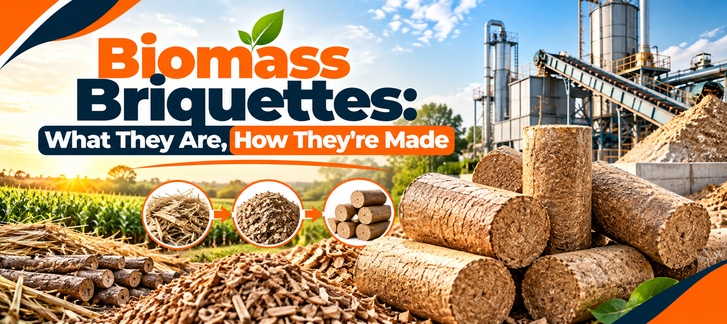
Quick answer: You know what a biomass briquette actually is? Just waste, pressed together until it holds a shape. Sawdust, rice husk, whatever's left over that nobody wanted to deal with.
Enough pressure and it sticks together on its own, no glue involved. That's really the whole trick. People burn them instead of coal or firewood in factory boilers, brick kilns, even at home for heating.
Drive past a rice mill or a cotton gin almost anywhere in Punjab or Sindh, and there's usually a small mountain of husk or stalks sitting off to one side. Nobody quite knows what to do with it, so it just piles up.
A briquette press turns that pile into something a factory boiler can burn on a schedule instead of a fire hazard waiting for a match. The idea behind it is almost embarrassingly simple. Squeeze loose material hard enough, and it holds its own shape. But that one simple trick has quietly changed how a lot of small industry sources fuel across South Asia.
This piece covers what biomass briquettes are actually made from, how the manufacturing process works step by step, what they tend to cost, who's really buying them, and where you'd go looking for a supplier in Pakistan.
What Are Biomass Briquettes Made Of?
Definition: Almost any dry organic waste can go into a press, honestly. Rice husk, cotton stalks, groundnut shells, sugarcane bagasse, wheat straw. These are the usual suspects, and they're cheap for a boring reason: there's just a huge amount of them lying around after harvest season, with nowhere else to go.
Wood waste is the other big source. Sawdust, offcuts from sawmills, scraps from small furniture workshops, the kind of material that used to just get swept into a corner and set alight at the end of the week.
Coconut shells, coffee husk, and waste paper show up too, though less often in what's produced locally in Pakistan. They run through the same presses without any trouble.
None of this is interchangeable, though. What goes into the block decides two numbers a buyer will always ask about before agreeing to anything. Calorific value, or how much heat comes off per kilogram, and ash content, or how much is left over afterward that someone has to clean out.
Ask anyone who has actually bought fuel like this before. The first real question is never Do you have briquettes. It's what they're made from............Read More
What biomass briquettes are, how they're made, what 1kg costs, who buys them in Pakistan, and where to source them at wholesale rates.
Quick answer: You know what a biomass briquette actually is? Just waste, pressed together until it holds a shape. Sawdust, rice husk, whatever's left over that nobody wanted to deal with.
Enough pressure and it sticks together on its own, no glue involved. That's really the whole trick. People burn them instead of coal or firewood in factory boilers, brick kilns, even at home for heating.
Drive past a rice mill or a cotton gin almost anywhere in Punjab or Sindh, and there's usually a small mountain of husk or stalks sitting off to one side. Nobody quite knows what to do with it, so it just piles up.
A briquette press turns that pile into something a factory boiler can burn on a schedule instead of a fire hazard waiting for a match. The idea behind it is almost embarrassingly simple. Squeeze loose material hard enough, and it holds its own shape. But that one simple trick has quietly changed how a lot of small industry sources fuel across South Asia.
This piece covers what biomass briquettes are actually made from, how the manufacturing process works step by step, what they tend to cost, who's really buying them, and where you'd go looking for a supplier in Pakistan.
What Are Biomass Briquettes Made Of?
Definition: Almost any dry organic waste can go into a press, honestly. Rice husk, cotton stalks, groundnut shells, sugarcane bagasse, wheat straw. These are the usual suspects, and they're cheap for a boring reason: there's just a huge amount of them lying around after harvest season, with nowhere else to go.
Wood waste is the other big source. Sawdust, offcuts from sawmills, scraps from small furniture workshops, the kind of material that used to just get swept into a corner and set alight at the end of the week.
Coconut shells, coffee husk, and waste paper show up too, though less often in what's produced locally in Pakistan. They run through the same presses without any trouble.
None of this is interchangeable, though. What goes into the block decides two numbers a buyer will always ask about before agreeing to anything. Calorific value, or how much heat comes off per kilogram, and ash content, or how much is left over afterward that someone has to clean out.
Ask anyone who has actually bought fuel like this before. The first real question is never Do you have briquettes. It's what they're made from............Read More

